
IDEAS & PERSPECTIVES | POSITION PAPER 01
India's Waste Management Problem Begins Before the Waste Is Generated
Why we need to shift from managing waste to preventing it at the source.
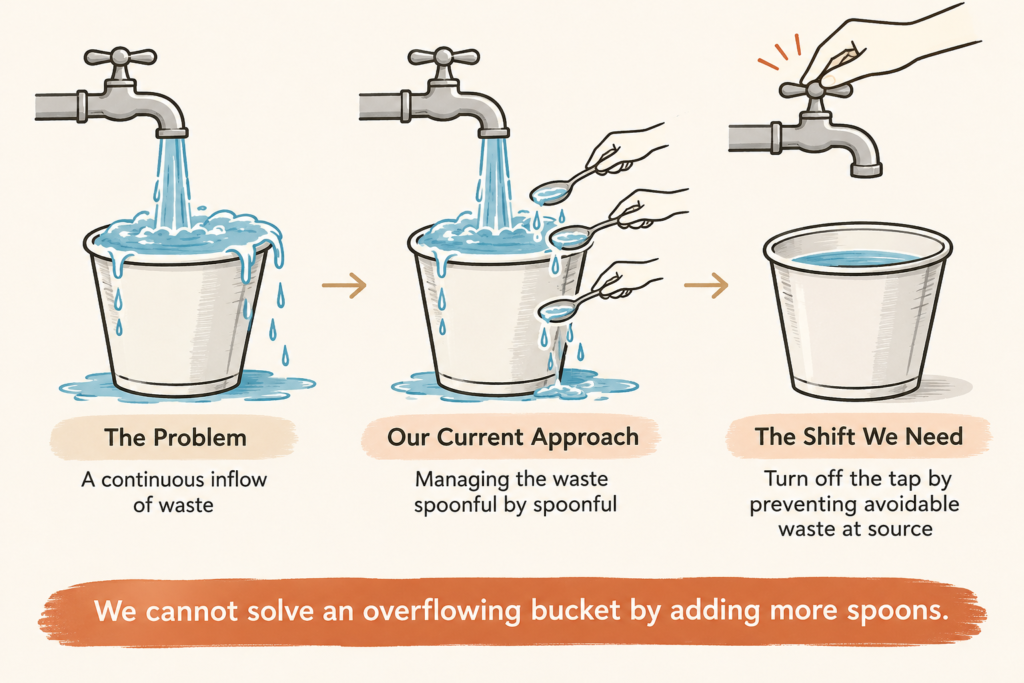
Our cities are struggling to manage the waste we generate. Yet, much of our attention and resources go towards managing waste after it has been created. What if we shifted our attention to preventing avoidable waste in the first place?
Aditi Deodhar | 16 November 2026
India’s waste management approach is disproportionately focused on managing waste after it is generated. Almost all our thinking about waste begins after the waste has already been created. At this point, the options are really limited. We can choose the best available option, or perhaps the least damaging of all the options, but that is about it.
And then there is the problem of increasing waste generation. With population growth, changing consumption patterns and changing lifestyles, the volume of waste is only likely to increase.
We are all waste generators. We contribute to waste every single day, some more and some less, but each of us generates waste in some form. Our changing lifestyles, especially urban lifestyles with their heavy reliance on e-commerce, home deliveries of goods and food, have added considerably to the waste burden.
The way we consume, the way products are packaged, the way goods are delivered and the way institutions procure materials all influence how much waste we generate. Waste generation is not merely a consequence of having more people. It is also a consequence of the systems that shape our consumption.
Our Current Waste Management Failure
If we cannot keep our cities clean right now, with the population we have, how are we going to manage this herculean task five, ten, or twenty years down the line, with a much larger population and increasing consumption?
Imagine a bucket placed under a tap that is turned on full. Water enters the bucket rapidly. The bucket is now almost full and about to overflow.
What would we do if we did not want the bucket to overflow?
Turn off the tap. Yes, the answer is intuitive, of course. Turning off the tap would avert the disaster.
Now imagine the bucket to be our city and the water falling from the tap to be the waste we generate. Our cities are drowning in waste. And what are we doing?
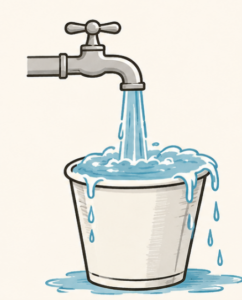
Managing waste is like removing water from the bucket spoonful by spoonful and hoping to solve the problem, while the inflow remains as is.
When we fail at that, when we see garbage heaps everywhere, we feel that we do not have enough spoons. So we increase the number of spoons. We now have more people pumping water out with spoons, and yet the problem persists.
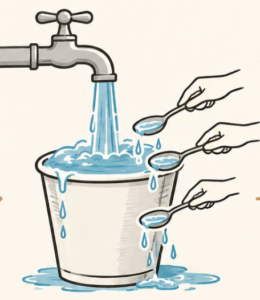
Because the solution was
to
TURN OFF THE TAP.
Turning Off the Tap
We need to shift the policy emphasis towards preventing avoidable waste at source. We need to move our focus beyond downstream waste management towards upstream waste prevention.
Consider the R framework, which starts with Refuse and Reduce, with Reuse and Recycle coming later. The framework recognises that preventing waste is preferable to managing it after it has been generated. While this hierarchy is widely accepted in theory, we rarely see the same priority being followed on the ground.
Refuse and Reduce are preventive interventions. They prevent waste from being generated in the first place or reduce the quantity generated. Reuse extends the useful life of products and delays their disposal. Recycling, on the other hand, is a downstream intervention. It comes into the picture after a material has entered the waste stream, attempting to recover its value and minimise the damage it can cause.
Consider a corporate office with thousands of employees using paper cups for beverages. A back-of-the-envelope calculation tells us that, assuming two cups per working day over approximately 200 working days, an employee could use around 400 paper cups annually. Imagine the annual paper cup consumption of an office with 100 employees. Or 1,000? Or 10,000?
A firm’s decision to refuse disposables and shift to reusables can reduce this waste immediately. Paper cups, particularly those with plastic linings, have limited recycling options and are often difficult to recover economically. They are likely to end up as waste, with additional waste and resource consumption from collecting and transporting them.
Refuse and Reduce are usually advocated in our personal lives, with slogans reminding us to carry a cloth bag when stepping out of the house.
But that is almost all we hear about. A few individuals avoiding plastic bags, though a good habit, are not going to be sufficient to solve the country’s waste problem. Switching from plastic bags to cloth bags is a useful individual action, but it is neither sufficient on its own nor the only intervention needed to address the larger waste problem. Sadly, we have not explored much beyond cloth bags when it comes to Refuse and Reduce.
Refuse and Reduce are ways of turning off the tap on waste. But when these preventive interventions are left entirely to individual behaviour, they become difficult to implement on the ground. They require changes in thought processes, consumption habits and lifestyles. Naturally, they face resistance from people at large and, often, from policymakers as well.
Recycling, on the other hand, is largely a technological intervention. It does not necessarily require us to change our consumption habits. It promises to take care of the mess after we have created it. One can continue living as before, which makes recycling an attractive option for citizens and policymakers alike.
But recycling has its own limitations. It consumes resources and energy and has environmental impacts. More importantly, it is not an equally effective or permanent solution for all materials.
Metals and glass, for instance, can generally be recycled repeatedly, although material losses and processing requirements still exist. Recycling metals can also save considerable energy compared to producing them from virgin raw materials.
Then there is plastic. Unlike metals and glass, many plastics undergo quality deterioration during repeated mechanical recycling. Their properties change, contamination and additives create further challenges, and the material may eventually become unsuitable for many applications. (Ministry of Housing and Urban Affairs, 2019)
This is why the term downcycling is often more appropriate when describing certain plastic recycling processes. The material is recovered, but its quality and potential applications may diminish with successive cycles. (Plastic Pollution Coalition)
In other words, plastic does not necessarily return to the resource cycle in the same quality or form in which it entered it. There are material limitations to how far it can be recycled.
For such materials, downstream waste management is not merely insufficient; it cannot, by itself, provide a permanent solution to the problem.
Recycling is important, no doubt, but it should not be prioritised over waste prevention. It is one of the solutions, certainly not THE solution to our waste problem.
The Challenge with Waste Prevention
Refuse and Reduce are effective, but equally challenging to put into practice.
Awareness in these matters hardly translates into substantial action. Awareness generation assumes that people will act once sufficient rationale has been provided to them. It hopes for action, but cannot guarantee it.
We cannot keep reminding a huge population about the ‘correct action’ all the time, especially in the fast-paced world we live in.
Instead, creating conditions where the correct action becomes the default choice is a much better and faster way of getting there.
There is another important consideration. Prevention interventions become truly meaningful when implemented at scale. A few individuals refusing disposable products is a good beginning, but the cumulative impact of institutional and systemic changes can be considerably greater.
And this is where policies come into the picture.
Overcoming Inertia Through Appropriate Policies
Refuse and Reduce may not be popular alternatives for people at large. But they can be made easier by changing the conditions in which people make everyday choices. We can make the desired behaviour the default behaviour by changing the rules and systems around us.
A school, for instance, has its own rules and regulations. A school decides the dress code for a child. It specifies the colour and kind of uniform, the shoes and the socks a child should wear every single day.
This becomes the default behaviour for the student and the parents, and it is easily followed. No child simply forgets to wear the uniform and goes to school in casual clothes.
Why can’t a school, which can establish and implement such everyday practices, also prevent avoidable plastic through its institutional policies?
What if a school made a good-quality steel tiffin box compulsory for every child, with child health as the primary consideration? The rationale could include concerns about chemical migration and microplastic exposure from plastic food-contact articles, along with the availability of a safe, practical and durable alternative.
A good-quality steel tiffin box lasts for years and is cost-effective over its lifetime. Unlike many plastic alternatives, it does not have the same concerns associated with polymer degradation and the potential release of chemicals and particles during use. Steel is also highly recyclable at the end of its useful life.
What if a school makes a steel tiffin box the default choice, with child health as the priority?
It becomes the accepted practice for students and parents, without leaving the entire responsibility of implementation to individual choices. This default choice can prevent the routine use of avoidable plastic food containers by hundreds of students in a single school.
Instead of hoping that recycling will clean up the mess, this choice prevents the mess from being created in the first place.
This is not merely a theoretical proposition. Through Mission City Chakra, an initiative at the Centre for Sustainable Development, Gokhale Institute of Politics & Economics, we have been working with schools in Pune to introduce institutional practices that prevent avoidable plastic use. The experience demonstrates how schools can move beyond environmental awareness and incorporate waste prevention into their everyday institutional practices. BBC Marathi has also covered this school-based initiative. (https://youtu.be/nTWMTY3cosA?si=KgayxSSWuGKRSPT0)
Going back to our office example, imagine an office administrator deciding to remove paper cups and provide steel glasses for beverages. This one-time purchase avoids repeated expenditure on procurement and disposal. This one institutional decision automatically changes the everyday behaviour of hundreds or thousands of employees.
Compare this with the current practice of conducting awareness sessions, appealing to employees to stop using paper cups and hoping that enough people will follow suit.
Instead of relying on repeated appeals and individual compliance, creating conditions where the desired action becomes the default is a much more effective strategy for reducing waste.
Implementing waste prevention measures at scale through institutional policies can also be considerably more cost-effective than continuously expanding downstream interventions such as collection, transportation, and processing.
Turning Off the Tap, To the Extent Possible
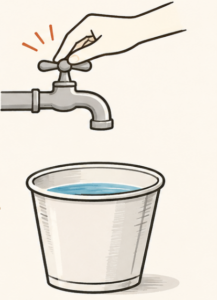
Everybody is a policymaker with an ability to turn off the tap to some degree.
Every household can implement measures that reduce waste or prevent materials from becoming waste in the first place. This is particularly relevant for wet waste such as kitchen waste, nirmalya and garden waste, where composting and other decentralised practices can prevent valuable organic material from entering the disposal stream.
One does not need to wait for the government to ban plastic bags to carry a cloth bag.
At a larger level, however, there are many more waste prevention measures that can be implemented without waiting for the ultimate policymakers at the state or central government level to take action.
Policymakers exist at every institutional level and within every establishment. A school principal, a corporate office administrator, a restaurant owner, a housing society manager or an event organiser can establish policies that influence the everyday practices of hundreds or thousands of people.
These are opportunities waiting to be explored.
Waste prevention does not need to begin with a national policy or a government directive. It can begin wherever someone has the authority to change a practice, establish a rule or redesign a system.
The idea is to make waste prevention an integral part of the way institutions function, so that the right decisions are made even before waste is generated.
Conclusion
We cannot turn off the tap completely. But we can certainly reduce its flow.
And perhaps that is where the future of waste management lies: not merely in getting better at managing the waste we generate, but in preventing as much avoidable waste as possible from being generated in the first place.
About the Author
Aditi Deodhar is a policy entrepreneur working at the intersection of urban sustainability, waste prevention, and institutional policy. She is the founder of Jeevitnadi – Living River Foundation and Brown Leaf, and leads Mission City Chakra at the Centre for Sustainable Development, Gokhale Institute of Politics & Economics, Pune.
References and Further Reading
- Ministry of Housing and Urban Affairs, Government of India. (2019). Plastic waste management issues, solutions and case studies. Government of India. sbmurban.org/storage/app/media/pdf/SBM Plastic Waste Book.pdf
- Plastic Pollution Coalition. What really happens to your plastic, “Recycling Guide https://www.plasticpollutioncoalition.org/what-really-happens-to-your-plastic-recycling-guide
- United Nations Environment Programme. (2023). Turning off the Tap: How the World Can End Plastic Pollution and Create a Circular Economy. UNEP. https://wedocs.unep.org/handle/20.500.11822/42277
- NITI Aayog. (2023). Report on Alternative Products and Technologies to Plastics and Their Applications. Government of India. https://www.niti.gov.in/sites/default/files/2022-07/Plastics%20Alternative%20Study_Final_Report_compressed.pdf
- Organisation for Economic Co-operation and Development. (2022). Global Plastics Outlook: Economic Drivers, Environmental Impacts and Policy Options. OECD Publishing. https://doi.org/10.1787/de747aef-en
- Ranjan, V. P., Joseph, A., & Goel, S. (2021). Microplastics and other harmful substances released from disposable paper cups into hot water. Journal of Hazardous Materials, 404, 124118. Microplastics and other harmful substances released from disposable paper cups into hot water – ScienceDirect
- Joseph, A., Parveen, N., Ranjan, V. P., & Goel, S. (2023). Drinking hot beverages from paper cups: Lifetime intake of microplastics. Chemosphere, 317, 137844. Microplastics and other harmful substances released from disposable paper cups into hot water – ScienceDirect
- European Commission. Waste Framework Directive – Environment – European Commission