
Discover how some of the biggest public-health breakthroughs—from smoking bans to lead-free petrol—were achieved not with perfect proof, but with powerful correlations. History shows that waiting for 100% certainty costs lives. Today, plastics and microplastics pose the same kind of threat, whether through tiffin boxes, water bottles, or everyday sachets. The Window for Preventive Action Is Now
When Correlation Is Enough: Why Plastic Needs Its Bloomberg Moment
Public policy rarely waits for perfect science—and thank goodness it doesn’t. If it did, we would still have lead in petrol, smoking in restaurants, asbestos in our walls, and DDT in our food chain. In the real world, health harms escalate faster than randomized controlled trials can be completed, and leaders must decide: act now or act too late?
This tension—between correlation and causation—is often used to delay action. But history tells a very different story: most major public-health victories were won on strong correlations long before scientists could prove the exact biochemical pathway.
And that is exactly why plastics and microplastics now need decisive, preventive action.
Causation vs. Correlation: The Big Difference
- Correlation tells you that two things are connected.
- Causation tells you one thing is responsible for the other.
In real-world policy, causation can take decades to prove scientifically. But correlation often gives enough warning to save lives early.
“When exposure is universal, early warnings must be taken seriously—waiting for perfect proof means exposing millions to avoidable harm.”
This is the exact same scientific and ethical stance used in:
- Bloomberg’s passive smoking regulation
- Banning leaded petrol
- Regulating asbestos
- Polio eradication’s precautionary strategy
- Silent Spring’s DDT reforms
- PFAS regulations underway today
Bloomberg Did It Without “Perfect Proof”—And Saved 10,000+ Lives
When New York City introduced the world-famous smoke-free law, passive smoking was strongly correlated with heart disease, lung cancer, asthma, and childhood respiratory distress. But—just as critics pointed out then—it was not the only factor. Air pollution existed. Diet existed. Stress existed. Multifactorial health systems are messy.
But Bloomberg made a crucial distinction:
Correlation + biological plausibility + scale of exposure = enough to intervene.
This simple formula changed the world.
NYC’s smoking ban worked because:
- second-hand smoke exposure was widespread
- strong correlations existed across decades of studies
- biological mechanisms were plausible
- and the potential benefits outweighed the risk of inaction
Within one year:
- ER visits for asthma dropped
- heart-attack admissions declined
- NYC saw measurable public-health improvements
The world applauded. No one waited for a perfect causal RCT.
Plastic Is in the Exact Same Stage Today
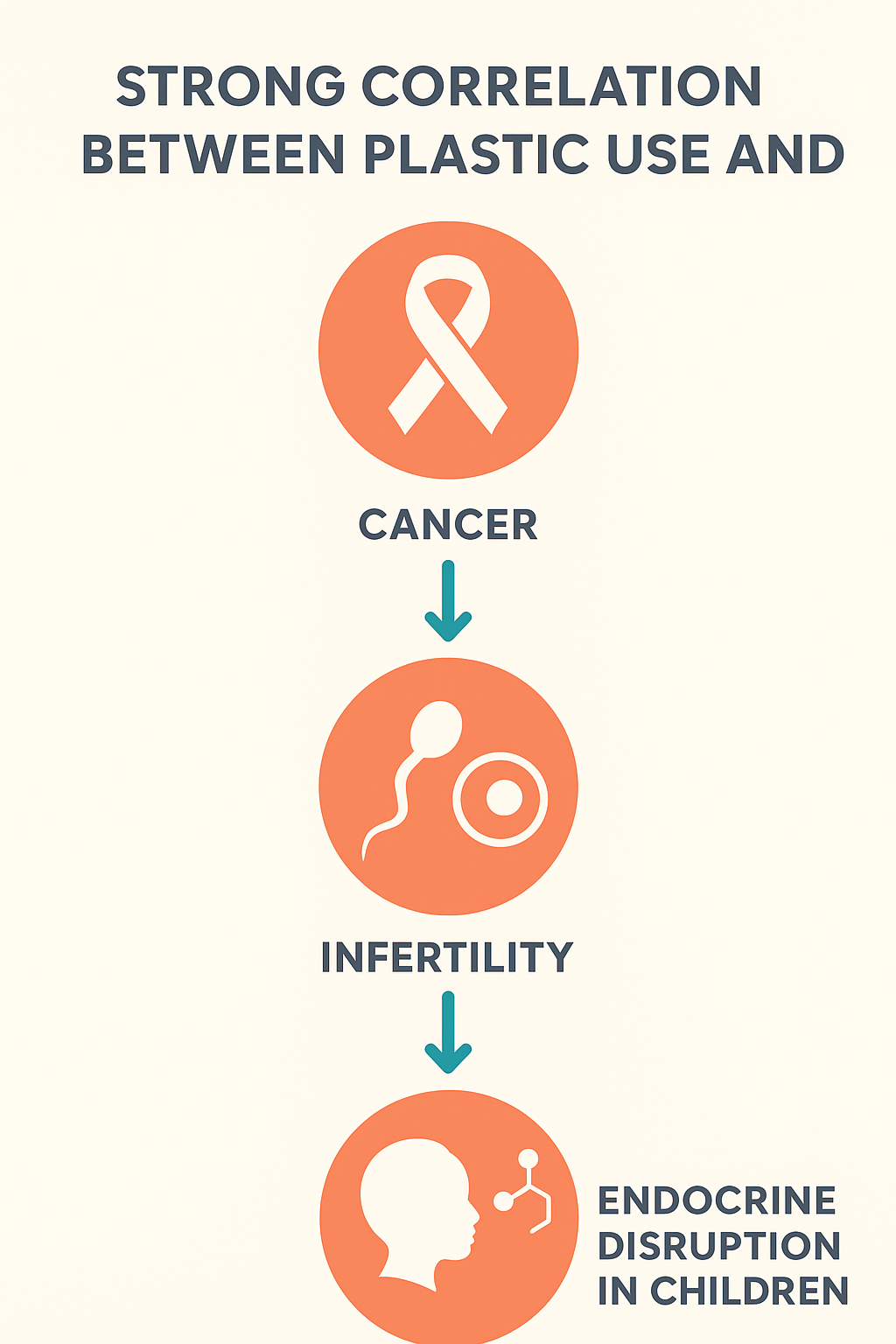
Plastics and microplastics—especially those containing endocrine-disrupting chemicals (EDCs) like BPA, phthalates, and styrene—are currently linked (not yet 100% causally proven) to:
- hormone-driven cancers
- early puberty
- reduced fertility
- pregnancy loss
- immune system dysfunction
- thyroid disorders
- metabolic diseases in children
Large-scale studies have found microplastics in:
- human blood
- lung tissue
- placenta
- breast milk
- and newborn meconium
Just like passive smoking, people are exposed without consent.
Just like passive smoking, the exposure is involuntary and unavoidable.
And just like passive smoking, waiting 20 more years for causal certainty is ethically unacceptable.
We Have Precedents: Public-Health Always Acts on Correlation First
- Lead in petrol and paint
For decades, the lead industry argued:
“Correlation is not causation.”
They insisted that crime rates, IQ decline, and developmental delays had multiple confounders. They were right—many factors were involved. But correlations were overwhelming, exposure was ubiquitous, and the biological mechanism was plausible.
Result: lead was banned, IQ rose, and crime fell globally.
- Asbestos
Rare cancers like mesothelioma were associated with asbestos long before scientists demonstrated definitive causal pathways. Policymakers banned it because the correlation was too strong to ignore.
- DDT and Rachel Carson’s Silent Spring
DDT was banned before the final toxicological proof arrived because:
- birds were dying
- eggshell thinning correlated strongly
- bioaccumulation pathways were plausible
Policy acted before science fully concluded. It saved ecosystems.
- PFAS and “forever chemicals”
Regulations are happening today because:
- strong correlations exist
- toxic endpoints are consistent
- global contamination is universal
Science continues, but precaution prevails.
So Why Should Plastic Regulation Be Any Different?
The industry’s favorite talking point is:
“There is no proof that plastics cause cancer in humans.”
But this statement is misleading. It hides three truths:
- A lack of proof is not proof of safety.
- Human long-term exposure studies are unethical, so perfect causal certainty may never come.
- We already have strong correlations + plausible biological mechanisms + massive exposure.
This is the exact threshold that justified smoking bans, lead bans, asbestos bans, DDT bans, PFAS regulation, and dozens of global health protections.
Plastics meet—and exceed—this threshold.
At Mission City Chakra, Centre for Sustainable Development, Gokhale Institute of Politics and Economics, Pune, we have started this preventive action with hundred of schools, and lacs of children in them,
About Mission City Chakra
Why Policy Entrepreneurs Must Move Before Science Finishes
Public-health leaders—from Rachel Carson to Bloomberg—did not wait for academic consensus. Their courage saved millions.
Plastic, especially food-contact plastic, now sits where tobacco sat in the 1980s and where lead sat in the 1960s:
High correlation. Strong plausibility. Massive exposure.
Low political will—until someone changes the narrative.
That “someone” is today’s policy entrepreneur.
So Yes—Correlation CAN and MUST Be Used for Plastic Policy
Here is the core argument policymakers can responsibly make:
- endocrine-disrupting chemicals are consistently associated with cancers, reproductive disorders, and developmental harm
- plastics are a major source of these chemicals
- microplastics are now found in nearly every organ tested
- exposure begins before birth
- waiting for “perfect proof” is dangerous
- historical precedent supports action
- the precautionary principle is a legal and scientific basis for regulation
Just like tobacco.
Just like lead.
Just like PFAS.
Just like asbestos.
The Window for Preventive Action Is Now
Every day of inaction:
- increases childhood exposure
- normalizes endocrine disruption
- raises the baseline of chronic disease
- and deepens the long-term policy burden
If Bloomberg had waited for perfect evidence, New York City would have lost another decade to smoking deaths.
If Rachel Carson had waited for perfect evidence, bird populations may have collapsed.
If policymakers wait for perfect evidence on plastics, we risk doing irreversible harm to an entire generation.
Acting on correlation is not “alarmist.”
It’s how every major public-health breakthrough has ever occurred.
Four main counter-arguments
People usually make four main counter-arguments when discussing health hazards from plastics. Here’s a clear breakdown you can use in blogs, public talks, and policy briefs:
1. “Correlation is not causation.”
This is the most common argument.
People say:
“Just because plastic chemicals are found in our bodies and cancer/obesity/infertility are rising doesn’t prove plastics caused them.”
Why they say this:
- Many diseases have multiple contributing factors (diet, genetics, pollution, stress).
- Industry uses this complexity to demand absolute proof, which takes decades.
How to respond:
- Many public-health measures—lead removal, tobacco regulation, asbestos bans—were implemented long before perfect causality was proven.
- When exposure is widespread and early evidence is worrying, waiting for proof can cause irreversible harm.
2. “Doses are too small to matter.”
People argue that the quantities of BPA, phthalates, microplastics, etc., are tiny and unlikely to harm health.
Why this argument is flawed:
- Endocrine disruptors behave differently: tiny doses can cause big effects, especially in pregnancy and childhood.
- Continuous exposure → bioaccumulation → higher long-term body burden.
- Children are more vulnerable due to lower body weight and developing organs.
3. “Regulatory agencies say it’s safe.”
Some rely on statements from agencies like FDA, EFSA, or BIS to argue plastics are within “safe limits.”
What’s missing:
- Agencies often rely on old toxicology models that assume “the dose makes the poison.”
- New research on microplastics, nanoplastics, and endocrine disruptors is much more recent and hasn’t yet fully entered regulation.
- Industry-funded studies have historically delayed regulation (same happened with tobacco, lead, PFAS).
4. “There is no proven rise in disease linked directly to plastic exposure.”
People say diseases are rising due to lifestyle, not plastics.
But evidence is growing:
- Microplastics found in blood, placenta, breast milk, organs.
- Higher phthalates/BPA linked to:
- Lower sperm count and fertility
- Hormone-related cancers
- Childhood obesity
- Thyroid disruption
- Early puberty
- Pregnancy complications
But because plastic exposure is everywhere, it is hard to isolate in studies—the same challenge we had with:
- Tobacco
- Lead in petrol
- Asbestos
- Air pollution
- PFAS (“forever chemicals”)
Yet all of these were eventually proven harmful after decades of denial.