
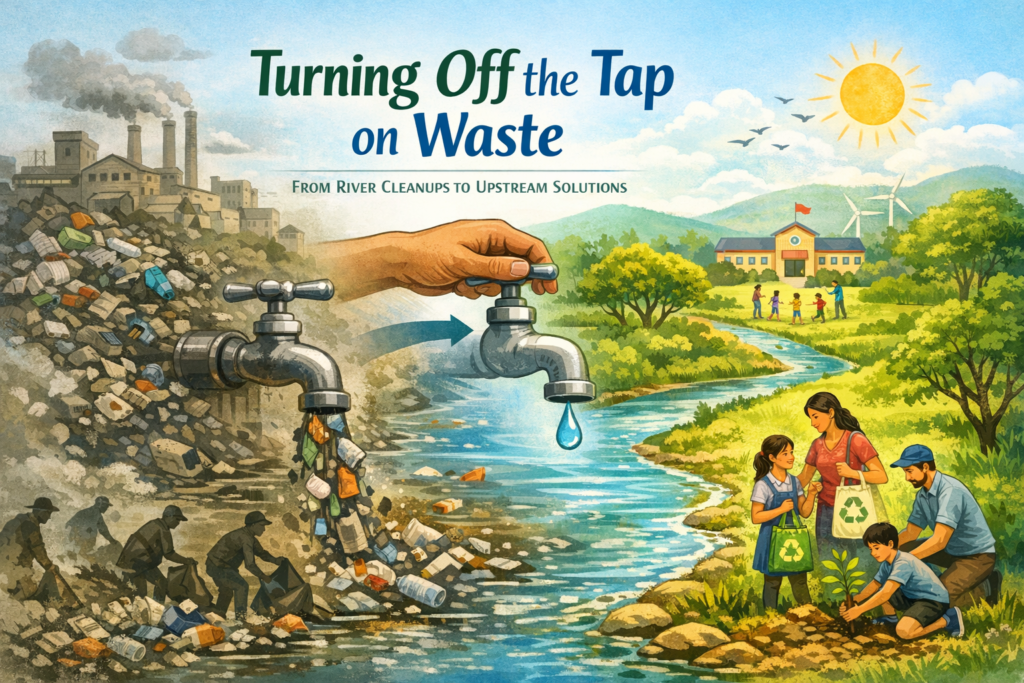
Mission City Chakra presents a scalable, upstream model that prevents waste at source by working with schools, institutions, workplaces, and system influencers.
From Cleaning Rivers to Turning Off the Tap on Waste
I co-founded Jeevitnadi in 2014 with a simple but urgent concern: our rivers were choking on garbage.
During our work on river stretches, we encountered every possible form of waste—plastic packaging, discarded household items, construction debris—both in the flowing river and settled deep into the riverbed. The scale of neglect was alarming, but it also sparked hope. We believed that if people could reconnect with their rivers, they would protect them.
At Jeevitnadi, we focused on river revival through people’s participation. Through our Adopt a River Stretch programme, citizens came forward to clean, care for, and emotionally reconnect with their local rivers. In many ways, this effort succeeded. We brought people back to the river. We built a movement. We created awareness, ownership, and visibility around rivers that had been forgotten.
Yet, despite years of effort, one uncomfortable truth became impossible to ignore.
The rivers were still not reviving.
When Action Treats the Symptom, Not the Cause
Over time, I began to realise something deeply unsettling.
By the time garbage reaches a river, it is already too late.
The problem has already been created upstream—in homes, markets, schools, offices, streets, and systems. What we were doing at the river was damage control. We were intervening at the end of the pipe, when the only option left was to reduce harm, not prevent it.
River clean-ups, though well-intentioned, were essentially shifting waste from one place to another—from the riverbed to trucks, landfills, or processing sites. We were not solving the problem. We were treating the symptom.
This realisation was uncomfortable, but necessary.
The Bigger Truth: Most of This Waste Was Avoidable
As we analysed the waste we were pulling out of rivers, another pattern became clear.
A large proportion of it should never have existed in the first place.
Single-use plastics. Disposable packaging. Short-life products. Poor material choices. Waste created by design, convenience, and lack of preventive thinking.
This was not a river problem alone.
It was a systems problem.
Why Prevention Matters More Than Cleanup
That’s when the thinking shifted fundamentally.
If we truly want to revive rivers, we cannot wait for waste to reach them. We must intervene upstream, where waste is generated—not downstream, where it accumulates.
We need preventive interventions that:
reduce waste creation itself
eliminate avoidable materials
change everyday systems and habits
protect ecosystems before damage occurs
This is not about abandoning clean-ups. They still matter for awareness and restoration. But they cannot be the primary strategy.
Turning Off the Tap on Waste
What finally became clear to me was this:
We don’t need better ways to clean waste.
We need to stop producing so much of it.
Instead of endlessly mopping the floor, we need to turn off the tap.
This thinking—born from years of river work—became the foundation for moving beyond end-of-pipe solutions toward upstream, preventive action. It shaped how I began to think about waste, health, materials, institutions, and behaviour.
Rivers taught me this lesson the hard way:
true revival does not begin at the riverbank. It begins far upstream—in our systems, choices, and designs.
From Realisation to Mission City Chakra
These years of working with rivers fundamentally reshaped how I understood the waste problem.
What became clear was that if we wanted to protect rivers, cities, and public health, we could not continue working only at the end of the pipe. We needed to intervene upstream, where waste is first created—long before it finds its way into drains, landfills, or riverbeds.
This realisation also led to another insight: individual behaviour change alone would never be enough. Waste is shaped by systems—by institutions, rules, norms, and defaults. To reduce waste at scale, we needed to work with those who influence how society functions on a daily basis.
This is how Mission City Chakra came into being.
Mission City Chakra was conceived as an upstream, preventive approach to waste—one that seeks to turn off the tap on waste rather than manage it endlessly. The initiative focuses on implementing waste reduction measures at scale by engaging policy influencers and decision-makers at different levels of society.
These include:
school principals who shape daily habits and norms for children and families,
institutional leaders who define operational systems,
workplace and facility administrators who influence procurement and usage,
market actors such as restaurants and suppliers, and
product designers who decide what materials enter everyday life.
By working with these intermediate policymakers, Mission City Chakra translates prevention into practice—embedding waste reduction into institutions, systems, and everyday routines.
What began as a lesson learned from rivers has now evolved into a city-scale effort to prevent waste before it exists.
Mission City Chakra is, at its core, an attempt to apply what rivers taught us—at the source, at scale, and with prevention as the guiding principle.