

Across Indian cities, bustling market streets like Pune’s Laxmi Road witness thousands of paper cups discarded daily — small but persistent contributors to plastic waste, clogged drains, and greenhouse emissions. These “single-use” items appear harmless but create massive hidden costs for urban sustainability and public health. Under the Mission City Chakra initiative by the Centre for Sustainable Development, Gokhale Institute, we propose a simple, scalable, and community-driven solution — empowering corporators to make their streets paper-cup-free zones. This initiative blends environmental leadership with citizen engagement, supporting India’s vision for Swachh Bharat, LiFE (Lifestyle for Environment), and Net-Zero Commitments. Through a Solution Card, corporators can access a ready project roadmap, including impact visualization, community outreach strategy, and SDG mapping, making it easier to communicate outcomes to voters, party leadership, and international observers. Together, we can turn every local tea break into a step toward a Zero Waste, Sustainable City
Author: Aditi Deodhar, Policy Entrepreneur & Founder, Jeevitnadi – Living River Foundation: River Revival through People Participation (www.jeevitnadi.org). Brown Leaf: Not a single dry leaf should be burnt in India (www.brownleaf.org)
CONTACT: Aditi Deodhar at missioncitychakra@gmail.com
Rethinking Everyday Waste in Our Cities
Every morning on Pune’s iconic Laxmi Road, hundreds of shopkeepers sip their tea in disposable paper cups. A small vendor walks briskly with a thermos and a stack of cups, serving warmth and routine. It’s a simple ritual — but multiply it by a hundred streets, every day, every month — and we begin to see the quiet scale of our single-use plastic problem.
Paper cups, though seemingly harmless, are lined with plastic film that makes them non-biodegradable. One paper cup can take 20 years to decompose, and every hundred such cups mean another kilo of microplastic creeping into our soil and water.
The Scale of the Problem
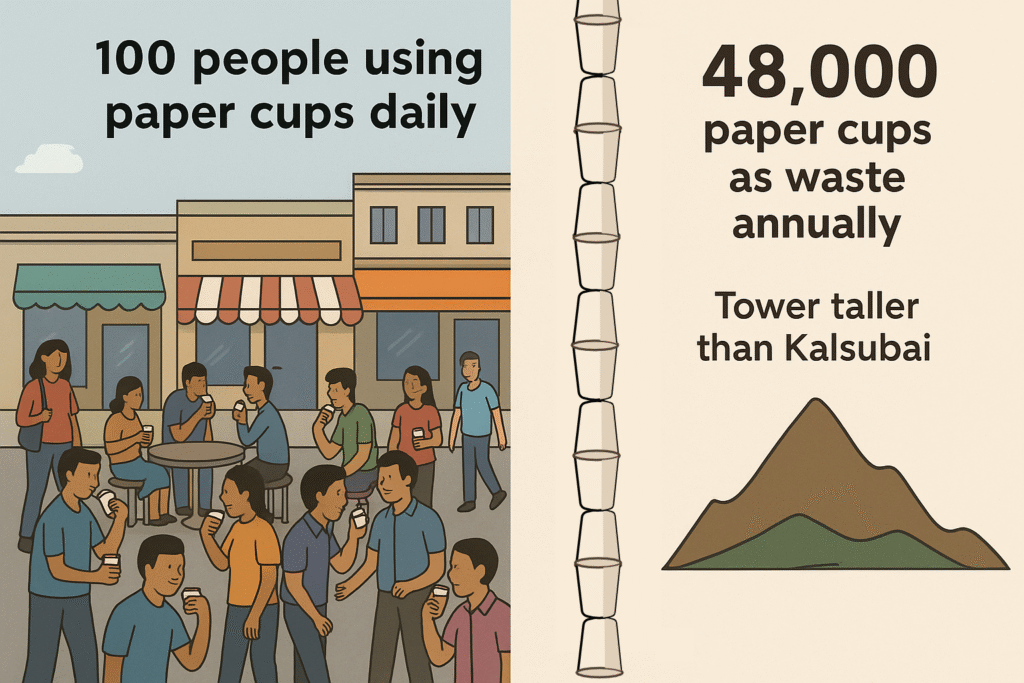
Let’s take just one busy street like Laxmi Road. If 100 people use paper cups daily, that’s about 48,000 cups every year — from a single street. If stacked alternately facing up and down, those cups would form a tower taller than Kalsubai, the highest peak in the Sahyadris. Now imagine the same habit across every market street in Pune.
This invisible mountain of waste contributes to landfill pressure, microplastic pollution, and greenhouse gas emissions — all from an act as ordinary as drinking tea.
ChatGPT estimates there are about 1600 shops on Laxmi Road. Imagine the Paper Cup Waste, quietly adding to landfill, clogging drains, and releasing microplastics into our food chain, impacting citizen health with direct and indirect exposure.
Empowering Local Leadership: The Corporator as a Change Agent
What if one corporator decided to change this story?
A simple local policy initiative could make a visible difference:
– Replace paper cups with steel or reusable glasses for all tea vendors.
– Conduct awareness campaigns highlighting health and environmental benefits.
– Establish paper-cup-free zones in busy commercial stretches.
This small shift could prevent tens of thousands of cups from entering the waste stream annually — setting an example of visible, replicable sustainability.
The Role of the Solution Card
To support such initiatives, we’ve developed a Solution Card — a concise, ready-to-use resource for corporators and civic leaders.
Each Solution Card provides:
✅ A clear problem statement with data-backed visualization
✅ A practical roadmap for implementation
✅ Awareness material for public communication
✅ Impact visualization report for voters and leadership
✅ Mapping to SDGs and national missions like Swachh Bharat and LiFE (Lifestyle for Environment)
The Paper Cup-Free Street Solution Card helps corporators launch a campaign that is not just about waste, but about public health, civic pride, and environmental responsibility.
Aligning with National and Global Goals
This initiative directly supports:
– Swachh Bharat Mission – by reducing non-recyclable waste at source
– Mission LiFE – promoting mindful consumption and circular living
– India’s Nationally Determined Contributions (NDCs) – through reduced plastic production and emissions
– SDG 11: Sustainable Cities and Communities
– SDG 12: Responsible Consumption and Production
It’s a small but meaningful step towards a Zero-Waste Pune City and a demonstration of how local leadership can contribute to India’s global sustainability commitments.
From Awareness to Policy Impact
When a corporator acts, citizens follow. A visible change on one road can inspire others — streets, wards, even entire cities — to rethink what ‘waste’ looks like. And when that story is told, it builds confidence in local governance, civic participation, and the belief that policy can emerge from everyday life.
A Call to Action
If you’re a corporator, citizen leader, or educator interested in making your ward paper-cup free, the Mission City Chakra team can help you with:
– A customized roadmap
– Awareness and engagement materials
– And an impact visualization report to communicate success
Together, we can make Pune’s streets cleaner, healthier, and more sustainable — one cup at a time.
About Mission City Chakra
Mission City Chakra is a city-scale initiative by the Centre for Sustainable Development, Gokhale Institute of Politics and Economics, led by Aditi Deodhar. It aims to create a Zero-Waste Pune City through citizen-driven policy enforcement, capacity building, and institutional collaboration.
Mission City Chakra is a project conceptualized by Aditi Deodhar and implemented under the Centre for Sustainable Development, Gokhale Institute of Politics and Economics.
About
Mission City Chakra is a project conceptualized by Aditi Deodhar and implemented under the Centre for Sustainable Development, Gokhale Institute of Politics and Economics.