
A Story of Dry Leaves, Human Ingenuity, and a City That Refused to Burn. By Aditi, the accidental leaf–matchmaker
Burning leaves causes smoke, asthma, and fire hazards. The Brown Leaf Project shows how Pune residents can mulch, compost, or donate dry leaves—turning waste into a resource.
Every Green City Has a Brown Side — And It’s Bigger Than We Think
Everyone loves a green city. Trees, shade, birds, cool mornings — the whole postcard.
But every green city has a brown side too.
No one talks about it, but you and I know exactly what I’m hinting at: Dry leaves. Mountains of them.
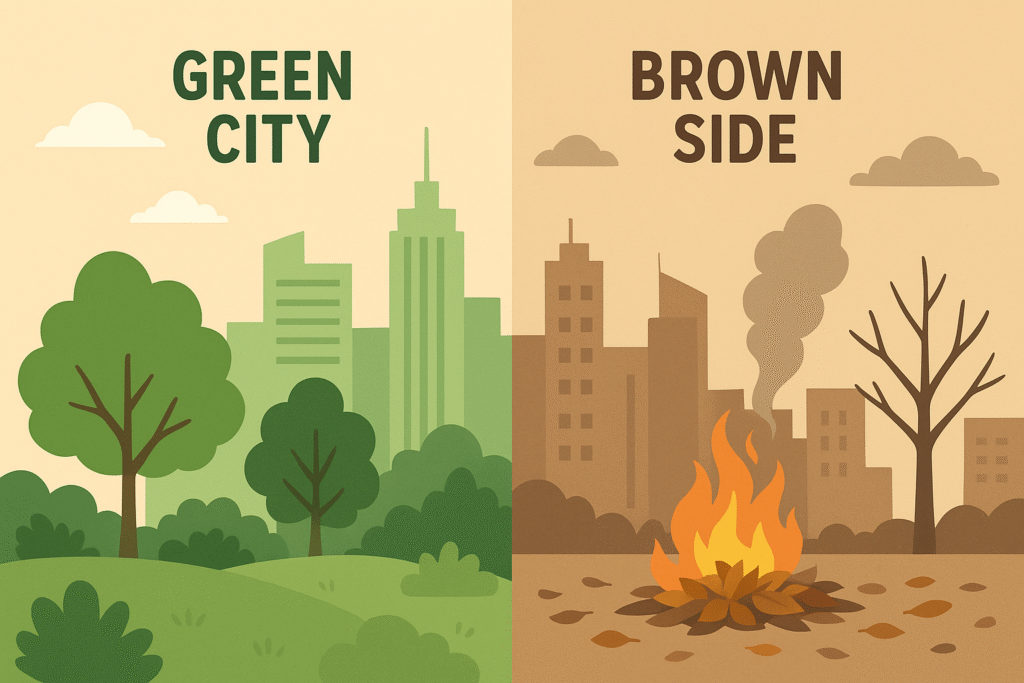
They fall silently, beautifully… and then sit on the ground like an unsaid problem. And for most people, the “solution” is painfully predictable:
One matchstick. A small fire. Problem gone.
Except… not really.
Because burning leaves brings a whole list of problems that arrive uninvited:
- Thick smoke that hangs in the air
- A choking smell that fills entire lanes
- Children coughing on their way to school
- Asthma attacks worsening overnight
- Elderly struggling to breathe
- Fire hazards everywhere — parked bikes, compound walls, boundary trees
And somehow, this still feels “normal,” because after all, dry leaves have to go somewhere… right?
That’s the brown side of every green city — not the leaves, but the burning, the lack of alternatives, the helplessness of citizens who know burning is wrong yet feel it’s the only workable option.
And this is exactly where our story begins.
How It All Started: One Woman, One Broom, and a Pile of Leaves (2016)
Back in 2016, I had no plans of becoming Pune’s unofficial “leaf dealer.”
I wasn’t dreaming of carbon sequestration, mulching systems, or circular economy models.
I was simply a Pune resident staring at a huge pile of dry leaves in my society… and a watchman slowly, regretfully, bringing out a matchbox.
Something in me snapped.
I remember thinking:
“Surely, there must be a better way than… setting nature on fire?”
And that tiny irritation — half environmental, half emotional — was enough to start a journey that eventually became the Brown Leaf Project.
The Big Insight: Dry Leaves Are Not Waste — They Are Wealth
Once I started digging, I realised something powerful:
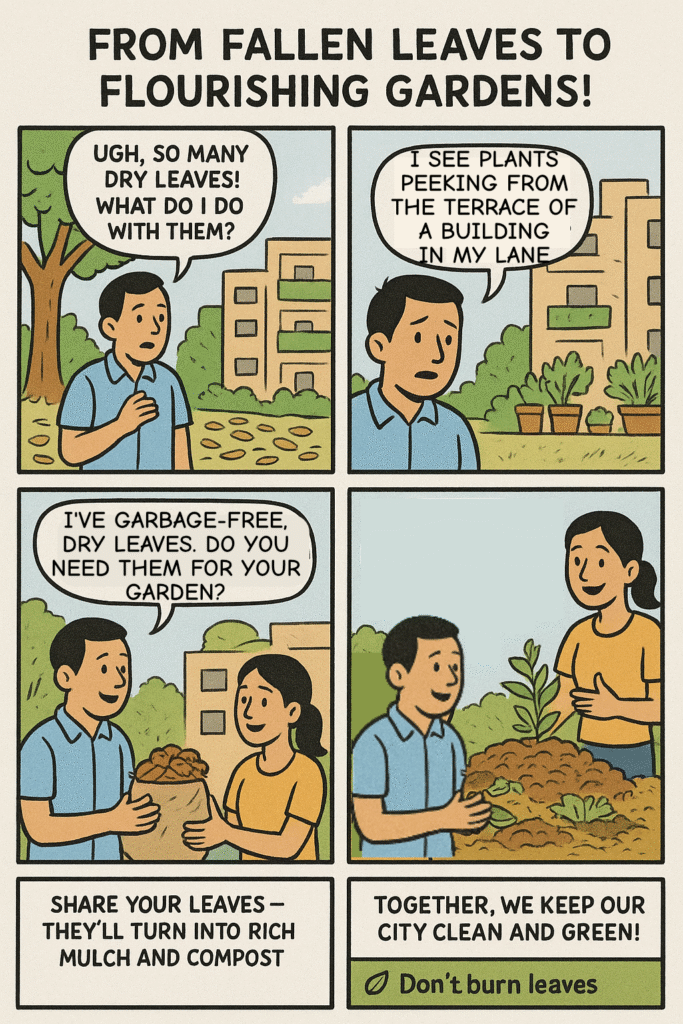
Dry leaves are not a waste problem — they are a resource distribution problem.
Some people have too many leaves and burn them.
Others have no leaves and go hunting for them because they desperately need mulch and compost material for their gardens.
Two groups.
Opposite problems.
Zero connection.
So I created one.
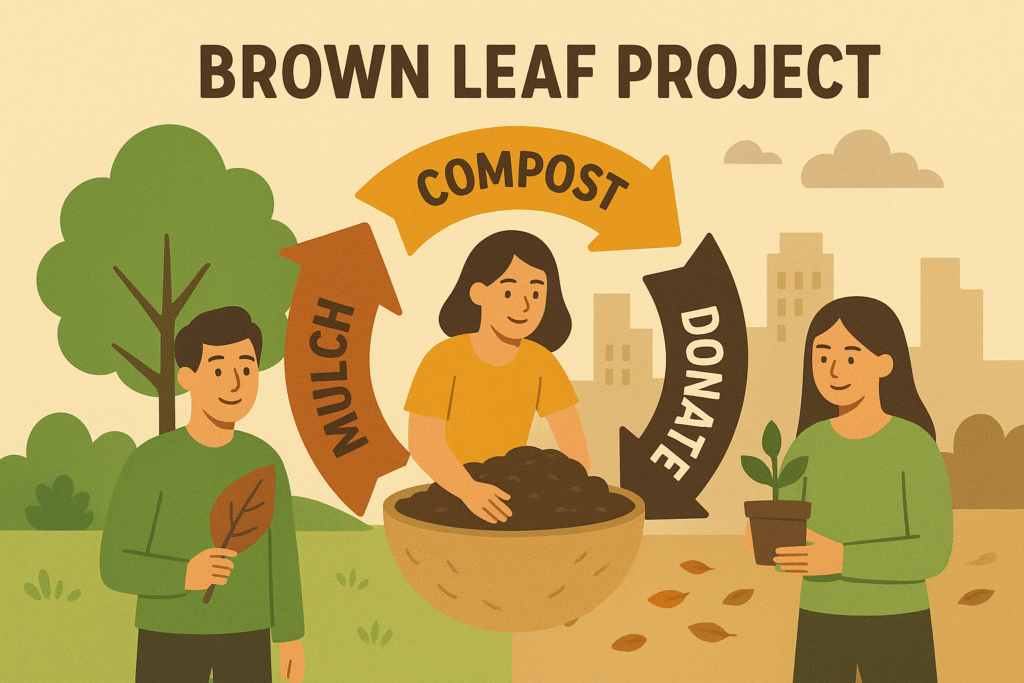
Mulch–Compost–Donate:
The Brown Leaf Strategy That Changed a City
The solution that
emerged was beautifully simple:⃣
Mulch it
Spread dry leaves directly in gardens, around trees, flowerbeds.
Nature invented mulching long before we did.
Compost it
Dry leaves + wet waste = beautiful, earthy compost.
And your plants will actually thank you.
Donate it
If you don’t want your leaves, trust me — someone else does.
Gardeners, farmers, nurseries, community composting sites, terrace gardeners…
There is an entire underground micro-economy that runs on dry leaves.
All they need is a connection. So Brown Leaf became a matchmaking platform.
Those who had leaves met those who needed leaves. And suddenly, “waste” stopped being waste.
A Quiet, Decentralised, Citizen-Led Climate Solution
Let me tell you something honestly: Brown Leaf is not glamorous.
There are no big machines. No high-tech sensors. No billion-dollar funding.
It works because it is:
- Local
- Simple
- Human
- Community-driven
- Emotionally meaningful
- Systemically smart
In systems thinking terms, I wasn’t tackling the symptom (leaf piles). I was tackling the root cause: the absence of alternatives.
We changed the system by creating a new behaviour pathway — one that doesn’t require burning at all.
Impact: Small Idea → Large City → Big Change
Over the years, the initiative has grown into a quiet movement:
- Thousands of leaf donors
- Thousands of leaf takers
- Countless WhatsApp groups
- Hundreds of gardens restored
- Compost pits revived
- Beautiful community interactions
- Entire neighbourhoods switching from burning to mulching
And the best part?
We didn’t need a law.
We didn’t need a policy.
We didn’t need enforcement.
We only needed connection.
Why Burning Feels “Easy” — and Why It Isn’t
Burning feels quick.
But the problems:
- Acrid Smoke
- Breathlessness
- Discomfort, Suffocation
- Asthma triggers
- Fire hazards
- Charred spots on streets
- Global Warming
…make burning a false convenience.
Brown Leaf gave people an option that is:
- Cleaner
- Safer
- Cheaper
- Healthier
- Planet-friendly
- Community-building
And surprisingly fun.
A Pune-Style Collaborative Eco-System
What I love about Brown Leaf is this: It created a community.
People don’t just exchange leaves — they exchange smiles, gardening tips, compost recipes, even saplings.
Some have become friends.
Some have started local compost groups.
Some have started terrace gardens because of the free mulch.
Brown Leaf became a mini–circular economy powered entirely by trust.
A Donella Meadows Moment: Changing the System by Changing the Paradigm
Donella Meadows famously wrote that the most powerful leverage point in any system is mindset—the shared assumptions and beliefs that shape behavior.
For leaf burning, the mindset was:
“Leaves are waste. Waste must be removed. Burning removes it fastest.”
Brown Leaf challenged this paradigm. We flipped “waste” into “resource,” and suddenly:
- People began storing leaves instead of burning them.
- Societies proudly reported compost quantities the way cricket fans report IPL stats.
- Gardeners walked around with the swagger of carbon warriors.
This wasn’t just behavior change. It was a mindset upgrade—a shift from waste removal to resource circulation.
And in systems thinking, that’s the holy grail.
Limitations (Because Every Honest Story Has Some)
- It works best where people have space for mulching or composting.
- Some neighbourhoods still lack leaf-takers.
- Not everyone has time for composting.
- Apartment complexes need collective decision-making.
- It takes awareness-building and patient conversation.
- Leaf donors exceed Leaf takers in numbers
The Strongest Point of Brown Leaf
It requires no new infrastructure. Only new intention.
It is zero-cost, zero-energy, zero-technology — and infinitely scalable.
A city with millions of trees needs millions of micro-solutions. Brown Leaf is one of them.
The Way Ahead: Scaling a Leaf Revolution
To truly embed this practice into Pune’s DNA, our next steps are:
- More awareness drives
- Linking with farms on the city periphery
- Similar system for curb-side leaves
- Mapping leaf donors and takers more comprehensively
- Training for communities on composting
- Institutional partnerships
- Encouraging gardeners to adopt it as standard practice
- Storytelling campaigns
- School awareness programs
This is not just “waste management.” This is climate action at human scale.
A Final Thought: Green Cities Need Brown Wisdom
If you ever feel your dry leaves are a burden, remember this:
Every leaf is returning to nature — it just needs your help getting there.
Burning destroys that cycle.
Brown Leaf restores it.
And the best part?
You don’t need to be an expert.
You just need to be willing to try.
From one citizen to another,
from one tree to another,
from one season to the next —
let’s keep Pune green… and its brown side peaceful.