
Discover how a simple, low-cost, community-led wetland restoration project at Vitthalwadi revived freshwater flow in the Mutha riverbed. A replicable model based on systems thinking, ecological principles, and citizen action.
By Aditi, the initiator of ‘Adopt a River Stretch Program, Jeevitnadi’
If you ever want to understand how cities slowly lose their rivers, don’t look at the floods or the sewage first. Look at the small things: the places where water stops flowing, tiny stagnations that slowly turn ecosystems—and then public imagination—murky.
In 2017–18, at Vitthalwadi on the Mutha riverbed, this is exactly what had happened.
A freshwater spring that once flowed freely into the river had been interrupted by years of “development”—channelization, blasting basalt rock, laying pipelines, dumping rubble, and the natural siltation that follows. The result was a string of stagnant, mosquito-friendly, stink-producing pools right in the middle of a historically sacred river stretch.
People held their breath while passing. They avoided the place.
Origin Story
When we first began the Adopt a River Stretch work at the Vitthalwadi section of the Mutha riverbed, the site was uninviting—stagnant pools, foul smell, and heaps of garbage had turned this sacred, historic space into an overlooked corner of the city. While spending time on the ground, one simple insight became clear to me: if we could remove the stagnation and reconnect the flowing stream back to the river, most of the problems would naturally resolve.
With this idea, I reached out to experts, Ketaki and Manasi at Oikos for Ecological Services, who immediately understood the intent and affirmed that the direction was sound. Their encouragement strengthened my conviction. Detailed discussions with Pooja and Prasanna, the founders of Lemnion Green Solutions, not only validated the concept further but shaped it into a concrete, implementable roadmap. Their expertise, clarity, and willingness to work alongside us played a key role in turning an initial intuition into a grounded community-led solution.
This project is a reminder that big transformations often start with simple ideas, strengthened by expert guidance and collective action.
Act I: How Flow Turned Into Stagnation
The Vitthalwadi stretch is special.
This is Prati-Pandharpur—a place where freshwater naturally emerges from two ancient Gomukh springs and a seasonal stream. For centuries, this fresh water joined the Mutha, giving it life, oxygen, movement.
Until the 2000–2010 decade, when several heavy interventions happened:
- The river was channelized.
- A sewage pipeline was laid in the riverbed.
- Basalt bedrock was blasted, fragmented rock dumped nearby.
- Floodwater carried silt that settled around these rock heaps.
- Together, these created raised mounds.
The flowing stream could no longer flow.
It simply got trapped.
Four stagnant pools replaced a running stream.
This caused:
- Mosquito breeding
- Black, stinking water
- A marshy mass instead of a fresh wetland
- A perception of “filthy place—avoid”
- Which then led people to treat it as a dumping site
This part is important.
When people turn away, garbage walks in.
Act II: A Simple Idea from Systems Thinking
“If you want to fix the system, find the leverage point.” — Donella Meadows
In the Vitthalwadi wetland project, the leverage point was not machines, money, or large tenders.
It was flow.
Restoring flow restores:
- oxygen
- self-purification
- ecology
- human perception
- and ultimately, public behaviour
A stagnant pool communicates hopelessness.
A flowing stream communicates possibility.
Once we saw this, the solution became beautifully simple:
Dig a channel between the stagnant pools → let water move again → let ecology take over.
No concrete.
No artificial materials.
No over-engineering.
No foreign elements in a river ecosystem.
Just flow.
Act III: The Big Idea Meets the “Start Small” Principle
The idea felt simple.
The execution felt… not so simple.
So we used the golden rule of real-world systems change:
Start Small. Learn Fast. Scale Smart.
This was pure Donella Meadows + pure Agile methodology:
Observe → Learn → Execute → Assess → Course-correct.
We picked the smaller of the two streams:
the Gomukh stream.
We identified four stagnant pools:
1 → 2 → 3 → 4 → river.
The plan:
Join them, one by one.
Let water flow from one to the next.
Strengthen edges with local rock.
Use native wetland plants like Typha and Taro to stabilize the channels.
It sounded doable.
And that was enough to begin.
Act IV: 20 Sundays, 50 Volunteers, 4 Experts — and Zero Cement
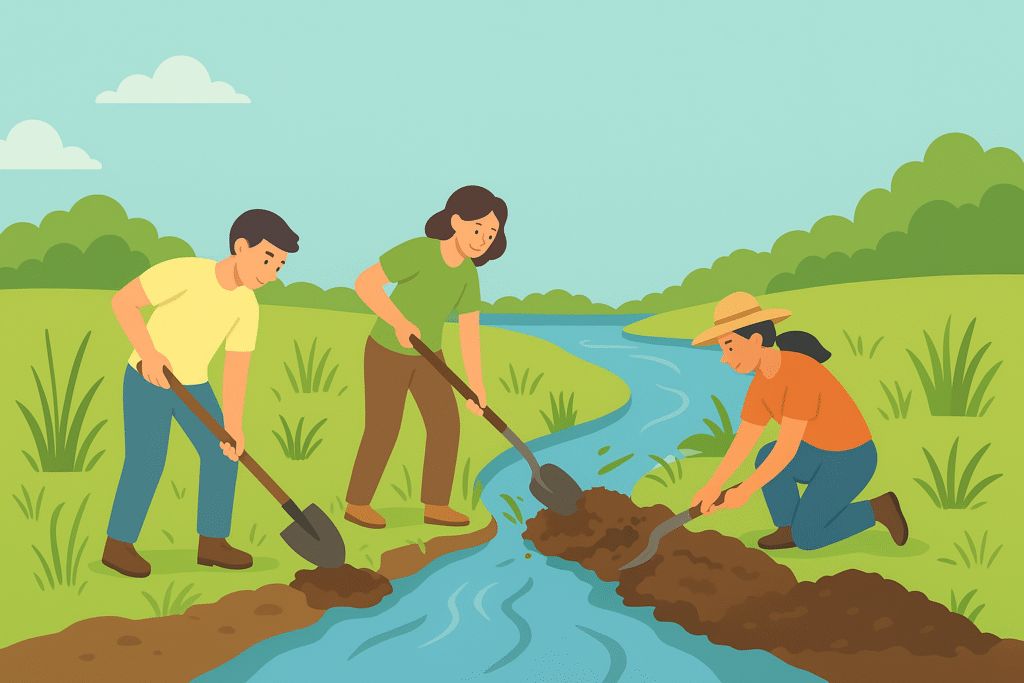
Every Sunday morning, teams assembled.
Tasks were assigned in a 5-minute stand-up meeting.
Volunteers picked whichever task they liked.
At the end of 2 hours, the progress was assessed.
Yes.
Just like a tech project.
Only muddier.
And happier.
People waded through knee-deep slush, moved rocks, cut channels, and occasionally jumped back from a passing crab or snake.
The water was black.
The smell was powerful.
The challenge was real.
And yet…
When the first thin ribbon of water trickled from Pool 1 to Pool 2, volunteers cheered louder than IPL fans.
Within weeks:
- Water started clearing.
- Flow strengthened.
- Rocks stabilized the edges.
- Plants rooted themselves and began filtering naturally.
- And the marshy stink faded into the past.
At the end of the 6th week, fresh, clean water flowed into the river again.
The river responded.
This sound—the small splash of water falling into the Mutha—was transformative.
People walking by paused, looked, smiled.
Where flow returns, hope returns.
Where hope returns, public care returns.
Act V: Scaling Up — The Second Stream
Once the pilot worked, the same process was replicated for the larger, more waste-laden stream.
More volunteers joined.
More boulders moved.
More channels carved.
In 20 Sundays, the work was done.
What This Project Achieved
Environmental Impact
- Freshwater flow restored
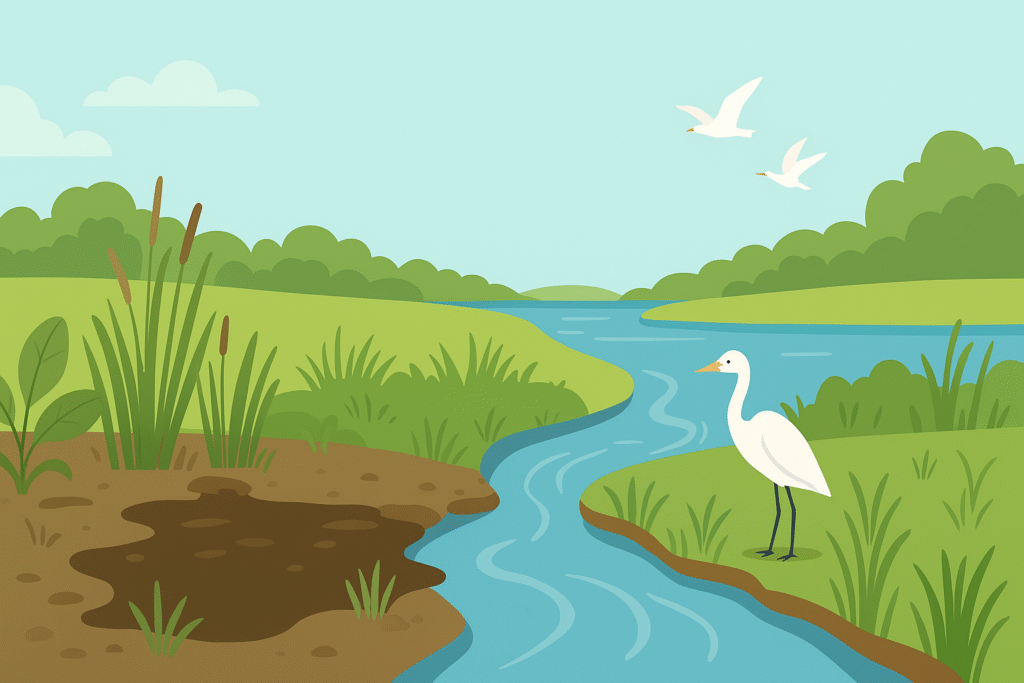
- Natural wetland vegetation revived
- Stagnation eliminated
- Mosquito breeding reduced
- Odour disappeared
- Water clarity improved
- River got continuous oxygenated input
Social Impact
- People returned to the river
- The site became a point of pride
- It reshaped perception of what citizens can do
- Zero-cost river revival became real
Systems Impact
This project demonstrated three powerful principles:
- Upstream Thinking: Solve the blockage, not its consequences.
- Leverage Points: Restoring “flow” changed everything.
- Community-led Ecological Restoration: The best interventions are the lightest, not the heaviest.
Act VI: Why This Matters for Pune (and Every City)
Every river has dozens of small streams and micro-wetlands.
Many of them suffer from the same problem:
Flow interrupted.
Ecosystem collapses.
Perception collapses.
Public care collapses.
This project shows how easily that pattern can be reversed.
Imagine if PMC replicates this not in one place, but in 20.
Imagine a riverbed alive with:
- small wetlands
- flowing freshwater pockets
- natural cleaning through plants
- microhabitats for birds and insects
- restored public confidence
Citizens achieved this in 2 hours × 20 Sundays.
Imagine what a municipal corporation with machinery can do.
Way Ahead — The Blueprint Is Ready
Jeevitnadi has already:
✓ Documented the process
✓ Identified similar sites
✓ Created a replicable model
✓ Published a case study with Wetlands International
✓ Produced a detailed booklet
Anyone — government, corporators, CSR teams, NGOs, student groups — can pick up this model and implement it.
**You don’t need heavy tenders.
You don’t need massive budgets.
You need just one insight:
Let rivers flow again.**
If you use the idea, simply credit:
“Courtesy: Jeevitnadi – Living River Foundation’s Wetland Development project at Mutha Riverbed, Vitthalwadi, Pune.”
Download this booklet to understand how we did at Mutha Riverbed, Vitthalwadi, Pune under the Adopt a River Stretch, Jeevitnadi program